

Stumbling over Microsoft’s Video Conferencing Dataset (VCD) I asked Claude to take on a video codec engineer’s favorite hot take: compare video codecs. It did a fairly good writeup using the tooling provided by libWebRTC. One of the most surprising results was that background blur makes H.264 a lot more effective. Other than that, the […]
Search Results for: turn
Vector Vibing to speed up Opus encode by 20%
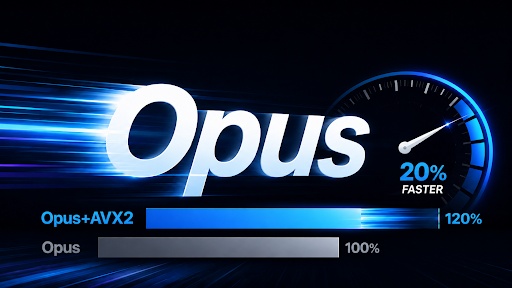
tl;dr: Opus encoding just got 20% faster on desktop Chromium by turning on AVX2 vectorization in libopus. Vectorization means one instruction doing the same arithmetic on a whole vector of values at once instead of one at a time. Codecs spend their hot loops running identical math across long buffers of samples, exactly where vectorization […]
WebRTC vs. MoQ by Use Case

This might be my first editorial style post here. Fippo’s Is everyone switching to MoQ from WebRTC? started some threads on MoQ vs. WebRTC. I started to respond, but my responses quickly became too long so I decided to go even deeper with a post here. Fippo’s post shows hard data that Media over QUIC […]
Is everyone switching to MoQ from WebRTC?

It is time for another edition of “Is everyone switching to…“. Cloudflare recently published a blog post about Media over Quic (MoQ) which made a number of statements about WebRTC that require some “clarification”. Let us start with that and look at MoQ and WebTransport after that. An odd understanding of WebRTC The blog post […]
How OpenAI does WebRTC in the new gpt-realtime

Earlier this month, OpenAI released the GA version of its realtime API. This includes many capabilities that the Beta didn’t have, including video support. I started out doing an update to the The Unofficial Guide to OpenAI’s Realtime WebRTC API I made for the Beta release last November. I discovered there were enough WebRTC updates […]